Saturday, October 24, 2026

Fw: Florida Wants to Put an Age Gate on the Entire Internet

Age gate on the net?  It won't stop there.

Reclaim The Net is funded by the community. If you support free speech and restoring privacy and civil liberties, please become a supporter here. Thank you.

October 23, 2026

SUPPORTERS

Installing an ad blocker and using one properly are two different things.

Most of the popular blockers ship in a mode their own makers consider the easy option. One of the biggest lets advertisers pay to get waved through. Firefox and Brave both keep their strongest protection switched off until you go looking for it. And a good deal of what passes for “blocking” does nothing for your privacy or security at all. The ad still loads. You just don’t see it.

That difference stopped being academic this week. Ads carried spyware onto household-name news sites and popular apps. The company had passed the industry’s vetting with every box ticked. One well-known blocker has a setting that would have stopped that exact delivery route. It comes at a cost, and its developer is blunt about what that cost is.

Then there’s the extension store. Fake ad blockers with millions of users have turned out to be botnets, sleepers that changed behavior days after install, and extensions bought outright from their developers by people you would not want reading every page you visit. Meanwhile, the world’s largest ad seller now sets the ceiling on how good an ad blocker can be in the world’s most used browser.

We explore this today.


This Story Is Exclusively for Reclaim The Net Supporters

Become a supporter to read it, unlock every supporter-only post, and help us challenge censorship and surveillance.

Become a Supporter

DIGITAL ID

Florida Attorney General James Uthmeier has announced a legislative proposal that would bring age verification to the app store, the operating system, and AI chatbots.

The announcement was made at Polk State College in Winter Haven, and Uthmeier was joined by Polk County Sheriff Grady Judd and education leaders.

Under the proposal, app stores and similar marketplaces would have to “determine the user’s age, link minors to a parent’s account, and obtain parental consent before a minor downloads or buys an app from a covered platform.”

In addition, the operating systems would have to “apply age-appropriate restrictions at the device level based on the user’s age,” while AI chatbot operators and platforms “must determine account holder’s age.”

The proposal, that has not yet been turned into a bill, is full of invasive promises, including that “all age determination must use commercially reasonable, privacy-protective methods,” as if that's possible.

However, no method is named, and this is the same promise made with most age-check laws, while reports of identity document leaks keep showing that the promise is not being kept. As Reclaim The Net reported in April, Discord’s earlier experiment with government ID age checks ended in a massive breach that exposed over 70,000 government-issued IDs.

Other provisions of the proposal include forcing social media accounts of those aged 14 to 17 to have a “quiet mode” that blocks access from 11 pm to 7 am, and from 8 am to 3 pm on school weekdays. The release says, “Muting notifications is not enough.”

For the same age group, screen time would be capped at two hours a day and 60 hours a month, “including messaging and long-form content.” Like counts would be hidden, autoplay and infinite scroll would be off unless a parent turns them on, and cosmetic filters would be disabled. Teen accounts would not be recommended to unconnected adults, who may not message them. Every three days, teens would get a prompt to switch to a non-personalized feed that they cannot dismiss.

Reports of child sexual exploitation would get human review within 48 hours, with a “one-strike” rule for adult offenders.

AI chatbots would not be allowed to offer minors features that “simulate companionship through personification, emotional engagement, user-data retention, unsupervised therapy, sexual content” or ones that “suggest the chatbot is a real human” or “encourage isolation or discourage help from appropriate adults.”

The press release said that knowing or reckless violations would be considered unfair practices under Florida Statutes section 501.1736, and would carry a fine of up to $50,000 per violation. The AG’s office would also be able to “maintain a public website to track incidents.”

Uthmeier said, “Parents deserve real control, and companies must design for safety, not addiction.” He also noted that “Florida already prohibits social media accounts for anyone under 14, and the Eleventh Circuit just upheld that law. The Safe Screens Act goes further.”

“If you invite Florida’s children onto your platform, you have a duty to keep them safe,” he also said.

Judd, meanwhile, praised the proposal, saying, “It takes the power and determination of an Attorney General to keep large social media and gaming companies from exploiting and endangering our children.”

State Rep. Jennifer Kincart Jonsson, a Republican from Lakeland, said, “Technology is changing faster than ever and we have a responsibility to make sure our laws keep up.”

The new proposal was announced by the state’s Attorney General, who cannot actually file a bill – that would have to be done by a member of the Florida House or Senate, and there has been no word on that yet. The 2027 legislative session is set to start on March 2.

Uthmeier faces reelection in less than two weeks, while his Democratic challenger, former state Sen. Jose Javier Rodriguez, reacted to the announcement by saying, “Florida families deserve an Attorney General who understands that protecting children matters more than political headlines.”

Meanwhile, the Eleventh Circuit ruled on October 14 that HB 3 is likely constitutional and threw out the injunction that had been blocking it. The law bans those under 14 from covered platforms and requires parental consent for those aged 14 and 15.

The court said the law works “not as an outright prohibition of platform usage but rather as a ‘conditional ban’ of sorts.”

However, the Computer and Communications Industry Association (CCIA) President Matt Schruers said the decision “risks imposing identity authentication on Floridian internet users of all ages.”

In her November 2025 dissent, Judge Robin Rosenbaum wrote that the law “effectively requires linking users’ identities (not to mention their parents’ identities) with users’ social media accounts.”

Reclaim The Net reported on October 8 that Uthmeier asked a court to order Meta to check the ages of its Florida users. The state opted out of the multistate settlement with Meta, with Uthmeier saying at the time, “Meta tried to get us to take their low-ball settlement, but we won’t sell out our kids.”

At the end of September, the AG asked a court to order OpenAI to implement “a robust and effective age verification system” for ChatGPT.

On October 16, Discord was sued for allegedly not scanning private messages thoroughly enough.

Each of the previous three lawsuits Uthmeier filed asked a court to order one company to implement age checks. But this proposal would write age verification into the phone itself – and the store every app comes from.

To find out who the minors are, you have to check everyone.

There is currently no text of the proposed bill, no information on what platforms would be covered, or what “privacy-protective” method would be used for age checks.

Make a Small One-Time Donation

Help keep this work going. Reclaim The Net relies on the people who believe privacy and free speech are worth defending. If you don't want to become a supporter you can still help by making a small one-time donation. Thanks for your support.

PRIVACY ON TRIAL

An Australian law firm has filed a class action in the Federal Court of Australia against Meta, claiming that Facebook and Instagram, through their “addictive design features and exposure to harmful content” harmed children.

The case, filed by MinterEllison on behalf of eight plaintiffs who say they were harmed by this while they were under 18, is seeking compensation. The case is funded by Litigation Lending Services.

It’s the “addictive design” claim that US courts and attorneys general have been using this year to force Meta to implement age checks for everyone – the remedy to the “problem” of “addiction” is to check the age of every user.

In the Australian case, the court issued a suppression order on Monday, October 19, preventing the publication of any information that could identify the plaintiffs and reveal the contents of the statement of claim.

Meta has told Reuters it would vigorously defend the claim.

Reuters writes that this might be the first lawsuit in Australia to try to hold social media platforms responsible for harm to their users.

MinterEllison partner David Taylor said, “The claims include allegations about Meta’s awareness of potential harm to children and its use of features designed to encourage engagement.”

Partner William Nolan added, “This proceeding raises important questions about the design and operation of social media platforms and their impact on children and teenagers in Australia.”

Litigation Lending Services chairman Shaun Bonétt said, “This class action is an important step towards ensuring that one of the world’s most powerful technology companies is held to account for conduct alleged to have caused widespread harm to children.”

The company’s chief investment officer Emma Colantonio said, “Without class actions and litigation funding, Australian families would have no practical means of pursuing these claims against a global technology giant.”

Meanwhile in the US, a jury in Los Angeles found in March that Meta and YouTube were negligent in the design of their platforms, and awarded a total of $6 million in damages to plaintiffs in the K.G.M. v. Meta case. The claim was built on how the platforms were designed, not on what users posted.

In that case, Meta CEO Mark Zuckerberg spent hours on the stand and at one point said that age checks should be done at the phone level, not by individual apps, saying, “Doing it at the level of the phone is just a lot cleaner than having every single app out there have to do this separately.”

In New Mexico, a jury in March ordered Meta to pay $375 million in civil penalties, and in August the judge in the case ordered the company to pay an additional $567 million into an abatement fund and to keep improving its “age assurance” models, and to build a model to predict whether a user is under 13.

That judge wrote that age verification “is the key to making Meta’s platforms safe for adolescents.”

In a multistate settlement announced on August 26, Meta will pay up to $16.68 billion over ten years, and apply “age assurance” to every Facebook and Instagram user in the settling states – both new and existing accounts.

In Australia, a ban on under-16s using social media has been in force since December 10, 2025, and platforms “must take reasonable steps to prevent age-restricted users having accounts.” Fines for non-compliance are now up to A$109.2 million.

Meta said it “removed access to more than 750,000 accounts on Facebook and Instagram in Australia” and uses AI to “analyze profiles – including posts, comments, bios and captions – for contextual clues that an account may belong to someone under 16.”

Meanwhile, Communications Minister Anika Wells said on October 20 that the eSafety Commissioner is preparing to take Facebook, Instagram, TikTok, Snapchat, and YouTube to the Federal Court for not complying with the ban.

“The law is not failing – platforms are failing to comply with the law,” Wells said.

There is also a High Court challenge to the ban, brought by Reddit and the Digital Freedom Project, who say it imposes “intrusive and potentially insecure verification processes on adults as well as minors.” The hearing is due in November.

The government is also considering new rules that would allow users to switch off algorithmic recommendations in their feeds.

Do social media users really need to be protected from “addiction” – or is it simply a useful label to pin on a company to force it to introduce age verification? A study published in Scientific Reports found that while only 2 percent of Instagram users showed clinical signs of addiction risk, as many as 18 percent said they felt addicted.

However, the study also said that “the addiction label does not empower users to regain control over their use.”

The details of the Australian lawsuit against Meta may be sealed, but the theory behind it is not new: call a feed an addiction, and the “solution” is to check the age of everyone using it.

In the US, each of the cases this year that have used this argument has resulted in some form of age verification being ordered or agreed to by Meta. Australia already has a law that requires age checks for under-16s, and is about to sue the platforms for not enforcing it properly.

A court win in the case of the “addictive design” would give the next round of age checks a legal precedent to rely on. And once again, it would be the adults, who were not party to the lawsuit, who would have to prove their age.

Wearing the merch or slapping a sticker on your laptop does two things: it keeps this work funded, and it puts the message where new people can find it.

→ Get yours here.

EMERGENCY CHAT

France’s Interior Minister Laurent Nuñez may not have been trying to advertise the messenger app bitchat when he said that “social networks are becoming a real problem” and that the government had the option of “suspending the use of the networks,” but that’s exactly what seems to have happened.

That statement was made on Wednesday, and by the next day, according to Sensor Tower, bitchat was the fourth most downloaded free app in France’s App Store and number one in the social networking category. Over the past 90 days, it rarely made it into the top 150 of all free apps or the top 100 in its own category.
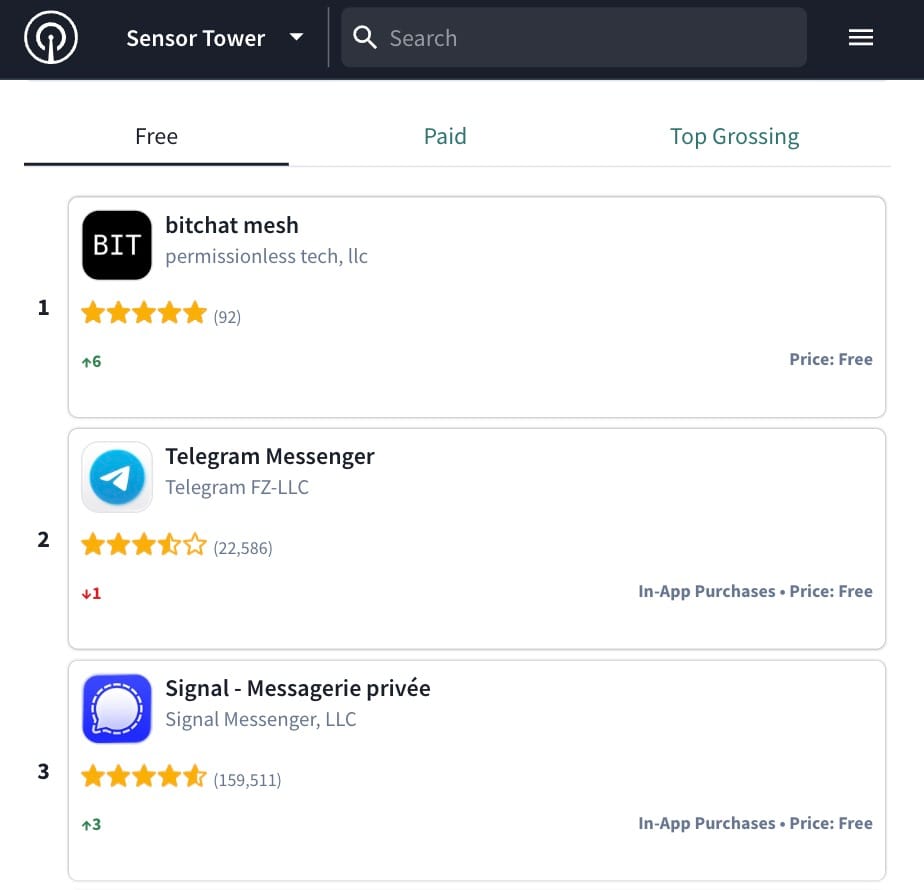
Sensor Tower ranking chart showing bitchat mesh at number one, Telegram Messenger at two, and Signal at three.
Bitchat is the number 1 free app on the App Store in France. Source: SensorTower

Nuñez also said, “The Conseil d’État in 2025 considered that, in principle, nothing prohibited it under exceptional circumstances, with very strict conditions, and it is something that has obviously not escaped me.”

The reference was to a ruling of the Council of State, France’s highest administrative court, on April 1, 2025, when it found that the block of TikTok in New Caledonia in May 2024, ordered by then-PM Gabriel Attal, was illegal.

The court said that the decision to block the video platform was “a disproportionate infringement of the rights and freedoms” of those who challenged it.

But the court left a door open, ruling that a block can be lawful if it is “indispensable to deal with events of particular gravity” and “no technical means allows alternative measures less harmful to rights and freedoms to be taken immediately” – and “for a limited duration.”

What was wrong with Attal’s decision was that it was “a total interruption of the service for an indefinite period linked solely to the persistence of the disorder.”

BFM, a French broadcaster, reported that for now there are no plans to shut down social media, but calls to download bitchat are multiplying.

The unrest in France started with riots and looting on October 17 and 18, with the government saying that at least 3,000 businesses were damaged or looted, and more than 2,400 people were arrested. More protests are planned for Saturday, October 24.

Attal, now the presidential candidate of the ruling Renaissance party for 2027, spoke about “a temporary, targeted block on the territories where the riots take place” in an interview with RTL on October 19, and on X, he reiterated, “during riots, we must be able to temporarily and selectively block access to certain platforms to stop the herd effect.”

Digital Minister Anne Le Hénanff held an emergency meeting with Discord, Meta, Google, Snapchat, TikTok, and X, to remind them to remove content that the government deems to be inciting violence or looting.

Meanwhile, a European Commission spokesman, Thomas Regnier, also on October 19, invoked the DSA (Digital Services Act) in saying that platforms must “make sure that their algorithms and services are not being misused in this context.”

On October 21, the Orange mobile network was down from 11:20 am to about 9 pm, with the company blaming a failure of core network equipment. It was the third national outage affecting the network this year.

Bitchat, on the other hand, is a messenger that does not depend on the internet or mobile network, and whose GitHub project is described as, “No accounts, no phone numbers, no central servers.”

Journalist Raphael Grably posted on X that the app, which is “encrypted and independent of the mobile network” has become the number one app on the App Store in the “social networking” category. The app’s creator, Jack Dorsey, also posted about it, saying only, “bitchat.”

The app uses Bluetooth Low Energy (BLE) to enable phones to relay messages to each other, with each phone acting as a relay – and with a range of about 30 meters (100 feet) per hop. Private messages are end-to-end encrypted with the Noise protocol. When a phone with the app installed has an internet connection, it switches to the Nostr network.

The App Store’s privacy label states, “The developer does not collect any data from this app.”

Other than being a messenger, the app can also “panic wipe” all data on the phone, and has been downloaded over a million times on Android, BFM is reporting.

Users who want to be able to communicate without the internet can download the app before the internet goes down, but there are limits to the app’s usefulness. “Bitchat is useless if nobody around you has it,” writes iGeneration, and adds that anyone in range who has the app can read the public channel.

This is not the first time that people are installing the app as a way to protect themselves from a possible internet shutdown.

We previously reported about this happening in Uganda in January 2026, where the communications regulator chief Nyombi Thembo warned that “it is very easy for us to switch off such platforms if the need arises.” Installs of the app jumped by several hundred thousand ahead of the election.

In April 2026, Apple pulled the app from the Chinese market at the behest of the Cyberspace Administration.

In July 2026, GitHub received an order to block the app’s code in India, and was given three hours to comply. Dorsey reacted by saying, “the government of India does not like technologies like BitChat and wants it taken down.”

In October 2026, Apple again removed the app from its store, this time in India, per a demand from the Ministry of Electronics and Information Technology (MeitY).

People in France did not wait for the authorities to tell them that a social media and internet shutdown might be in the works; they went ahead and installed the one app that, by virtue of its technology, cannot be shut down at the level of the network. And the government’s own court has already ruled that such a blackout is illegal, yet the authorities are still looking for ways to implement it, reading the ruling as in fact giving them the right to do so under certain conditions.

The weak point of an app like this is not the signal it uses, but the app store from which it is downloaded, and through which it is updated.

Two governments have already managed to have it removed from the Apple store, and in a France that keeps summoning tech platforms for talks, the app store is the next place a ban would likely land. The time to install the app is before anyone asks you to remove it.


ENCRYPTION UNDER SIEGE

Signal has once again stated it will not make changes to its app to comply with Canada’s Bill C-22 (the Lawful Access Act) – and would rather leave the country than do that.

Proton, the Swiss privacy company, has also made its position clear: it will not accept the bill’s metadata rules, and has already dropped the idea of making Canada the home of its North American headquarters.

Proton’s chief technology officer Bart Butler was blunt: “Any sort of extended metadata requirements beyond what we’re obligated to do as a Swiss company would be probably a no-go for us from a compliance standpoint.”

The bill was passed in the House of Commons on June 18 and is now in the Senate, where it had its second reading debate on October 8. It remains there.

In June, the country’s Public Safety Minister Gary Anandasangaree added some amendments to the proposed law, in an attempt to make it more palatable to privacy and rights advocates and companies that would be affected by its provisions.

One of the amendments was to make sure that a company that does not hold the key to its encrypted data would not have to decrypt it. Another was to limit the amount of time internet and phone companies can be made to keep metadata – from a year to six months.

The minister’s spokesman Simon Lafortune says that the legislation “explicitly states that it does not require the decryption of end-to-end encrypted information and does not permit or compel companies to introduce systemic vulnerabilities or so-called ‘backdoors’.”

However, Signal is not convinced. On October 5, its vice-president of strategy and global affairs Udbhav Tiwari spoke at an Ottawa panel organized by the Canadian arm of the Internet Society, and the session was recorded for Senate committees.

Tiwari said the amendments still allow for ministerial orders “that can be ruinous for encryption and privacy for all Canadians.” Signal could still be forced to make changes to its software “that negates the very purpose of encryption itself – and that is something that is a very strong red line.”

Tiwari explained that this week, Signal stores only a phone number, the date an account was created, and the last time it connected.

If Canada were to demand that it start storing metadata, “For us this is a serious enough issue that it would fundamentally break Signal,” Tiwari said.

Given the choice of “creating a much weaker version of our product that collects all of this metadata, the choice for us, unfortunately, would be starkly clear: we will not make changes to our product – which is open source and available for anyone to verify – to comply with such demands that place the privacy of not just Canadians but everyone else in the world at risk.”

Mozilla, another tech company that was at the Ottawa event, is also unhappy with the bill. Christian Sadilek, a senior principal software engineer, said that the bill could force companies to build weak points into their products, which AI tools can now quickly discover, “which can autonomously scan vulnerabilities, detect them, and find ways to break in.”

He also explained that metadata can be very revealing, and give away “almost every detail about a user,” including their religion and “what diseases they are struggling with.”

Butler told The Globe and Mail on October 21 that the planned expansion into Canada, with a North American headquarters there, is now off.

He added that “we would not pull out of Canada in the sense that we would not stop offering services in Canada, but we would certainly not expand in Canada, hire in Canada, do other things.”

“As democratic as Canada remains today, I think it’s also fairly naive to expect that the good guys will always be in power,” he said.

Meanwhile in the Senate, the bill’s sponsor, Baltej Dhillon, has told fellow senators that “Bill C-22 does not authorize mass surveillance” – and said he avoids the phrase backdoor access “because it alludes to a whole bunch of different things that are not true.”

Senator Paula Simons, however, said the bill would allow the government to make providers keep “the metadata of all their Canadian customers for six months just in case the police should ever have cause to look something up.”

This, she said, is a heavy burden, “especially for companies such as Signal, which retain little or no metadata now, or only retain it for a few days or hours.”

In May, Signal’s Tiwari said that the company would “rather pull out of the country than be compelled to compromise on the privacy promises we have made to our users.”

Even the June amendment to C-22 that is supposed to protect end-to-end encryption by saying that companies that do not have the key to unscramble data will not be forced to decrypt it actually leaves the door open to achieving the same via metadata.

In the case of Signal, this means that even if the app does not hand over the content of messages, the authorities could get information about who the user communicated with, when, and from where. And this is information that Signal does not currently collect.

If you want this work to keep going, you can become a supporter here.

Thanks for reading,

Reclaim The Net


Reclaim Media

86-90 Paul Street

EC2A 4NE


No comments:

Post a Comment